Sacred Circle / ArticlesSacred Circle / Artigos

Reflections,
tales and ideas.

Reflexões,
contos e ideias.

Legends carried by fire, and the quieter thoughts that circle back to us between ceremonies.

Lendas transmitidas pelo fogo, e os pensamentos mais silenciosos que retornam a nós entre as cerimônias.

Dreamcatcher against the sunlight

How the Dreamcatcher came to the people

Como o Apanhador de Sonhos chegou ao povo

Iktomi the spider, a vision on a high mountain, and a web spun to sift the good dreams from the bad.

Iktomi, a aranha, uma visão numa montanha alta, e uma teia tecida para separar os bons sonhos dos maus.

Long ago when the world was young, an old Lakota spiritual leader was on a high mountain and had a vision. In his vision, Iktomi, the great trickster and teacher of wisdom, appeared in the form of a spider. Iktomi spoke to him in a sacred language that only the spiritual leaders of the Lakota could understand.

As he spoke, Iktomi took the elder's willow hoop — which had feathers, horse hair, beads and offerings on it — and began to spin a web. He spoke of the cycles of life: how we begin as infants, move to childhood, then adulthood, and finally old age, where we must be cared for as infants again, completing the cycle.

"But," Iktomi said as he continued to spin, "in each time of life there are many forces — some good and some bad. If you listen to the good forces, they will steer you in the right direction. But if you listen to the bad forces, they will hurt you and steer you the wrong way."

When Iktomi finished speaking, he gave the elder the web and said: "See, the web is a perfect circle, but there is a hole in the center. Use it to help yourself and your people reach their goals, making good use of their ideas, dreams and visions. If you believe in the Great Spirit, the web will catch your good ideas — and the bad ones will pass through the hole."

The Lakota elder passed this vision on to his people, and the Sioux now hang the dreamcatcher above their beds to sift their dreams and visions — the good ones are held in the web of life; the evil ones escape through the hole in the center and are no longer part of them. They believe the dreamcatcher holds the destiny of their future.

Há muito tempo, quando o mundo era jovem, um velho líder espiritual Lakota estava numa montanha alta e teve uma visão. Em sua visão, Iktomi, o grande trapaceiro e mestre da sabedoria, apareceu em forma de aranha. Iktomi falou com ele numa língua sagrada que apenas os líderes espirituais Lakota conseguiam entender.

Enquanto falava, Iktomi tomou o arco de salgueiro do ancião — que tinha penas, crina de cavalo, contas e oferendas — e começou a tecer uma teia. Falou sobre os ciclos da vida: como começamos como crianças, seguimos para a infância, depois para a vida adulta e, por fim, para a velhice, onde precisamos ser cuidados como crianças novamente, completando o ciclo.

"Mas," disse Iktomi enquanto continuava a tecer, "em cada momento da vida existem muitas forças — algumas boas e outras más. Se você escutar as forças boas, elas o guiarão na direção certa. Mas se escutar as forças más, elas o ferirão e o guiarão na direção errada."

Quando Iktomi terminou de falar, entregou a teia ao ancião e disse: "Veja, a teia é um círculo perfeito, mas há um buraco no centro. Use-a para ajudar a si mesmo e ao seu povo a alcançar seus objetivos, aproveitando bem as ideias, sonhos e visões do seu povo. Se você acreditar no Grande Espírito, a teia captará suas boas ideias — e as más passarão pelo buraco."

O ancião Lakota transmitiu essa visão ao seu povo, e os Sioux hoje pendem o apanhador de sonhos sobre suas camas para filtrar seus sonhos e visões — os bons ficam retidos na teia da vida; os maus escapam pelo buraco no centro e deixam de fazer parte deles. Eles acreditam que o apanhador de sonhos guarda o destino do seu futuro.


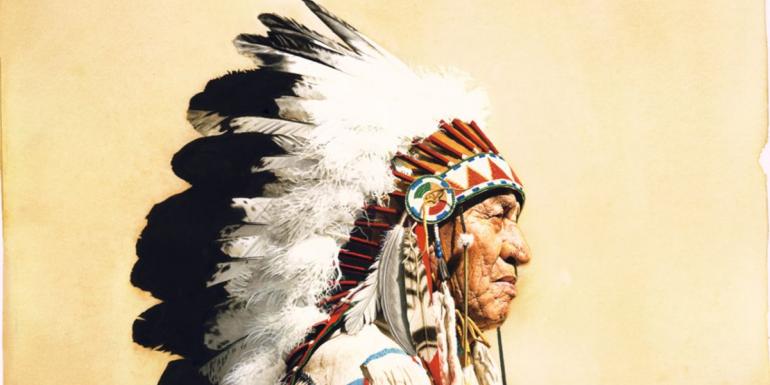
Cheyenne chief portrait

The legend of the Dream Catcher

A lenda do Apanhador de Sonhos

A mother, a frightened child, and a round net woven to fish the dreams from the lake of the night.

Uma mãe, uma criança assustada, e uma rede circular tecida para pescar os sonhos no lago da noite.

A long time before the white man arrived, there lived in a Cheyenne village a little girl called "Fresh Cloud." One day she told her mother, "The Last Breath of Night," that at nightfall a black bird would arrive to feed on pieces of her — until her mother, light as the wind, came and threw the bird out.

With motherly love, "The Last Breath of Night" reassured her child that the things she saw at night were called "dreams," and the black bird was only a shadow that came to save her. But Fresh Cloud said she was afraid, and wished to see only the white shadows, which are good.

So the wise mother, to help her child overcome her fear, created a round net "to fish the dreams in the lake of the night," and gave it a particular magical power: to recognize the good dreams — important for Fresh Cloud's spiritual growth — from the bad ones, deceptive and without meaning. She made many dream catchers and placed them over the cradles of the whole village. As the children grew, they made their dream catchers more and more beautiful, and their power grew with them.

Each Cheyenne keeps their dream catcher for life, as a sacred object carrying strength and wisdom. Even today, whenever a child is born, a dream catcher is made and placed over the cradle: a flexible wood is shaped into a circle representing the universe, and a web is woven inside like a spider's — meant to catch and keep every dream the child will have. If the dreams are positive, the dream catcher entrusts them to the beads (the force of nature) and they come true; if negative, they are handed to the feathers of a bird, which carries them far away, scattering them across the sky.

Muito tempo antes da chegada do homem branco, vivia numa aldeia Cheyenne uma menina chamada "Nuvem Fresca". Um dia ela contou à sua mãe, "O Último Suspiro da Noite", que ao cair da noite um pássaro negro chegava para se alimentar de partes dela — até que sua mãe, leve como o vento, chegava e expulsava o pássaro.

Com amor materno, "O Último Suspiro da Noite" tranquilizou a filha, dizendo que as coisas que ela via à noite se chamavam "sonhos", e que o pássaro negro era apenas uma sombra que vinha salvá-la. Mas Nuvem Fresca disse que estava com medo e que queria ver apenas as sombras brancas, que são boas.

Então a mãe sábia, para ajudar sua filha a superar o medo, criou uma rede circular "para pescar os sonhos no lago da noite", e deu a ela um poder mágico particular: reconhecer os bons sonhos — importantes para o crescimento espiritual de Nuvem Fresca — dos maus, enganosos e sem sentido. Ela fez muitos apanhadores de sonhos e os colocou sobre os berços de toda a aldeia. Ao crescerem, as crianças tornavam seus apanhadores de sonhos cada vez mais bonitos, e seu poder crescia com elas.

Cada Cheyenne guarda seu apanhador de sonhos por toda a vida, como objeto sagrado, portador de força e sabedoria. Ainda hoje, sempre que uma criança nasce, um apanhador de sonhos é feito e colocado sobre o berço: uma madeira flexível é moldada em círculo, representando o universo, e uma rede é tecida dentro dele, como a de uma aranha — feita para capturar e guardar todos os sonhos que a criança terá. Se os sonhos forem positivos, o apanhador de sonhos os confia às contas (a força da natureza) e eles se realizam; se forem negativos, são entregues às penas de um pássaro, que os leva para longe, dispersando-os pelo céu.

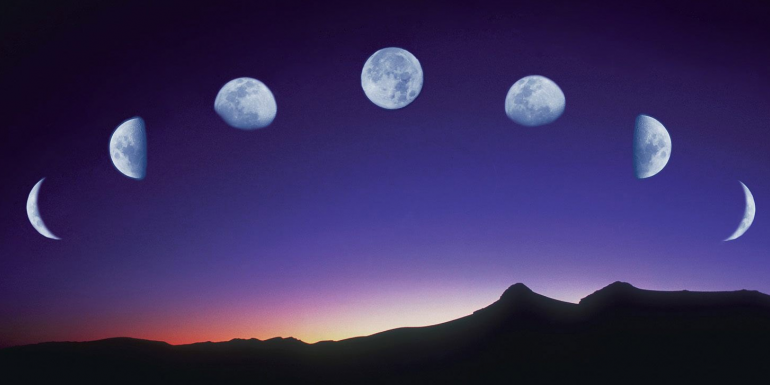
Phases of the moon over a mountain range

The Moon and its influence

A Lua e sua influência

Fertile, hot, barren, cold — the four faces of the Moon, and the tides they raise in a body made of water.

Fértil, quente, estéril, fria — as quatro faces da Lua, e as marés que ela ergue num corpo feito de água.

To survive, people have always lived in constant harmony with the rhythms of the Moon; many significant monuments show how important the observation of the stars and the Moon was to the ancients. Even Darwin, in "On the Origin of Species," notes that man — like all animals and birds — is affected by the mysterious force of the lunar phases, in events as common as pregnancy, plant growth, harvests and healing.

Our ancestors found that many phenomena in nature — tides, births, the menstrual cycle — are tied to the Moon's phases, and that many animals follow its position: birds, for instance, gather nesting material only at certain times, so the nest can dry more quickly after rain.

Our body reflects the influence of our satellite: since we are made of up to 65% water, we too are affected by "biological tides" within our arteries and veins. During the New and First Quarter (Crescent) Moon, all fluids expand — we call this the Fertile Moon, fertile and "wet" like the reproductive quality of the Earth. From the First Quarter to the Full Moon it is considered "hot" — heat as a source of dynamic energy, able to create motion, passion and intensity, and to produce growth, expansion and affirmation. This Moon gives all its potential energy toward accomplishing things.

On the contrary, as the Moon wanes it becomes barren, no longer fertile — "dry," like land that bears no fruit, a desert. So from the Last Quarter to the New Moon, the Moon is "cold" — as cold as the Earth in winter, waiting for the renewal of spring. Water is Life.

Para sobreviver, os povos sempre viveram em harmonia constante com os ritmos da Lua; muitos monumentos significativos mostram como era importante, para os antigos, a observação das estrelas e da Lua. Até Darwin, em "A Origem das Espécies", diz que o homem — como todos os animais e aves — é afetado por essa força misteriosa que vem das fases da lua, em eventos tão comuns quanto a gravidez, o crescimento das plantas, as colheitas e os processos de cura.

Nossos ancestrais descobriram que muitos fenômenos da natureza — marés, nascimentos, o ciclo menstrual — estão relacionados às fases da lua, e que muitos animais seguem sua posição: os pássaros, por exemplo, recolhem material para seus ninhos apenas em certos momentos, para que sequem mais rapidamente depois da chuva.

Nosso corpo reflete a influência do nosso satélite: como somos feitos de até 65% de água, somos afetados por "marés biológicas" dentro de nossas artérias e veias. Durante a Lua Nova e o Primeiro Quarto (Crescente), todos os fluidos se expandem — chamamos isso de Lua Fértil, fértil e "úmida" como a qualidade reprodutiva da Terra. Do Primeiro Quarto até a Lua Cheia, ela é considerada "quente" — o calor como fonte de energia dinâmica, capaz de criar movimento, paixão e intensidade, e de produzir crescimento, expansão e afirmação. Essa lua dá todo seu potencial energético para a realização das coisas.

Ao contrário, quando a Lua está minguante, ela se torna estéril, já não fértil — "seca", como uma terra que não produz frutos, um deserto. Assim, do Último Quarto até a Lua Nova, a Lua é "fria" — tão fria quanto a Terra no inverno, esperando a renovação da primavera. Água é Vida.

Weathered portrait, ink and paper texture

Silence screams

O silêncio grita

In the spirit of Crazy Horse — and Leonard Peltier, still speaking from a cell after 37 years.

No espírito de Crazy Horse — e de Leonard Peltier, ainda falando de sua cela depois de 37 anos.

Silence, they say, is the voice of complicity. But silence is impossible. Silence screams. Silence is a message, just as doing nothing is an act. Let who you are ring out and resonate in every word and deed. Yes — become who you are. There's no sidestepping your own being or your own responsibility. What you do is who you are. You are your own comeuppance. You become your own message. You are the message.

In the spirit of Crazy Horse — Leonard Peltier. From his cell in the federal prison at Lewisburg, Pennsylvania, after 37 years he keeps right on struggling for the rights of Indigenous people. He has contributed to the establishment of libraries, schools, scholarships and battered women's shelters, among many other projects. He was nominated for the Nobel Peace Prize in 2004 and again in 2007. "My crime's being an Indian. What's yours?"

O silêncio, dizem, é a voz da cumplicidade. Mas o silêncio é impossível. O silêncio grita. O silêncio é uma mensagem, assim como a inação é um ato. Deixe que quem você é ressoe em cada palavra e em cada gesto. Sim — torne-se quem você é. Não há como escapar do próprio ser ou da própria responsabilidade. O que você faz é quem você é. Você é seu próprio ajuste de contas. Você se torna sua própria mensagem. Você é a mensagem.

No espírito de Crazy Horse — Leonard Peltier. De sua cela na prisão federal de Lewisburg, na Pensilvânia, depois de 37 anos ele continua lutando pelos direitos dos povos indígenas. Contribuiu para a criação de bibliotecas, escolas, bolsas de estudo e abrigos para mulheres vítimas de violência, entre muitos outros projetos. Foi indicado ao Prêmio Nobel da Paz em 2004 e novamente em 2007. "Meu crime é ser índio. Qual é o seu?"